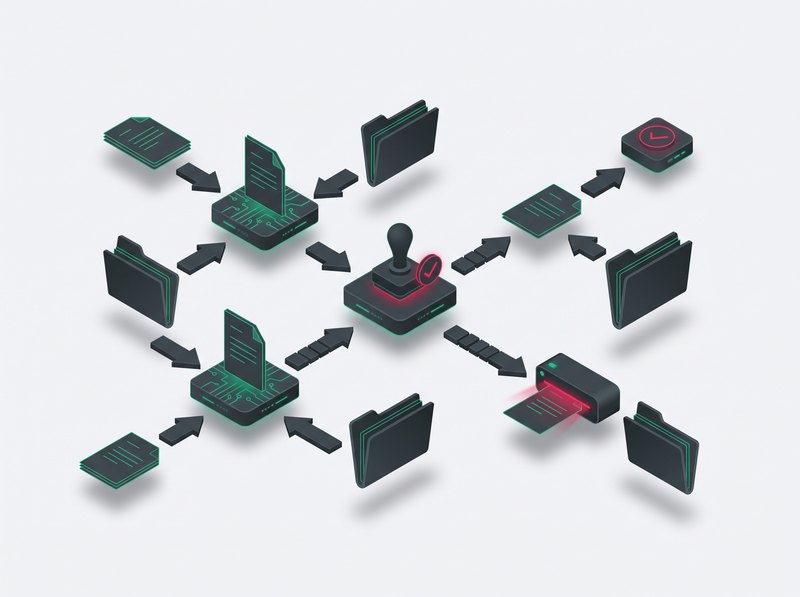
Finance departments are not only the subject of digital transformation, but often also its initiators. CFOs are increasingly expected to become leaders of technological development. To drive change, they need tools and… a skilled team. This support is provided by self-service business applications. See why digital transformation without programmers is possible!
Digital transformation without IT
Business digitalization is not only about technology that enables faster data processing or automation of tasks, but also about the ability to analyze information and draw meaningful conclusions.
That is why CFOs need not only tools for process digitalization, but also a team ready to take on new challenges and develop new skills.
In times of a shortage of developers and expensive, time-consuming implementations of advanced systems, no-code technology and application-building platforms come to the rescue.
No-code is a fully self-service technology for users without technical skills. It allows employees to build systems using ready-made components: modules, widgets, templates, and more.
Applications enable rapid process automation by the people who know these processes best — without the need for developers.
Applications take over repetitive, time-consuming tasks, freeing employees to focus on more valuable work.
In such conditions, they can engage in solving complex problems, creative tasks, and developing innovative products and services — things that machines cannot replace (at least for now).
Reducing dependence on IT allows digital transformation to happen faster, more efficiently, and at significantly lower cost.
Employees also gain new skills, enabling them to work more effectively in a digital environment.
Finance automation
But what exactly can business applications do? Let’s look at the finance department as an example.
Up to 30% of finance professionals’ time is spent correcting and verifying documentation and recreating reports and settlements — tasks that can be automated first.
So if you are tired of:
- lack of full process control
- waiting for reports and filtering data manually
- combining data from multiple files
- lack of visibility into process stages
- signing stacks of documents
- time-consuming and complex reporting
- errors in settlements and fraud risks
…it’s time to replace spreadsheets or your current system with a financial application!
All manual tasks — paper requests, form filling, copying, compiling and sending data, reporting and reconciliations in spreadsheets — can be replaced with a single application for all processes.
Qalcwise applications allow you to:
- manage company-wide budgets and track execution
- manage projects and investment expenses
- forecast and settle sales
- manage invoice workflows and document repositories
- handle business travel expenses and reimbursements
- create pricing and cost simulations
- manage bonuses and commissions
- monitor data in real time
- create on-demand reports and analytics
By automating these processes, companies ensure faster operations and reduce errors and fraud.
Finance directors gain full process transparency, better control, higher security, and can expand the digital ecosystem across the organization.
One platform for everything
Within a single Qalcwise platform, all organizational processes can be automated and integrated: HR, administration, sales, marketing, operations, logistics, and more.
Applications allow you to automate any business process while preserving its specific characteristics and improving accuracy.
With Qalcwise you can:
- define tasks and goals
- build custom forms
- design workflows
- assign roles, tasks, and permissions
- connect forms to any database
- trigger notifications and alerts
- integrate with external systems
- do all of this on any mobile device
No other software on the market enables such versatile, advanced, and yet easy-to-implement automation.
Qalcwise allows companies to digitize processes without pain and without IT involvement.
So the answer to the title question is: Yes — CFOs can become drivers of successful digital transformation. Digital transformation without IT is possible.