Introduction
Effective collaboration between organizations involved in different stages of product development is essential to delivering successful projects. This was the challenge faced by a Qalcwise customer whose operations required continuous data exchange and coordinated decision-making between two closely cooperating companies.
The projects covered multiple interconnected activities—from product preparation and quality management to operational processes and manufacturing—requiring seamless coordination across teams working in parallel within separate organizational structures. As the number of initiatives increased, maintaining consistent information and efficient communication became critical.
To support this way of working, the organization needed a solution that would provide structured project management, flexible business process automation, and real-time access to accurate data throughout every stage of project execution.
Challenges before the implementation
As collaboration between the organizations expanded, so did the number of projects, the volume of data, and the complexity of business requirements. Existing tools could no longer keep pace with the organization's growth and changing needs, prompting the search for a more flexible solution.
"The number of projects eventually became too large to manage effectively with our existing tools. At first, spreadsheets allowed us to coordinate our work efficiently, but as the organization grew, they were no longer enough.
Together, these challenges demonstrated the need for a centralized and flexible solution capable of managing a growing number of projects, data, and business processes across collaborating organizations.
Why did the organization decide to look for a new solution?
The need for change first emerged in the manufacturing part of the organization. As the number of graphic design projects and the volume of data grew rapidly, existing tools—including spreadsheets, Trello, and local databases—were no longer able to support the business efficiently. Changing customer requirements, varying process standards, and the need for frequent updates made it increasingly difficult and time-consuming to keep information accurate and consistent.
The organization needed a solution that would enable faster responses to change, simplify process modifications, and centralize data without the cost and complexity of traditional software development. This led the team to look for a platform that could be implemented quickly, adapt to evolving business needs, and support continuous development without writing code.
The Qalcwise No-Code Platform proved to be the best fit, providing the flexibility, speed, and scalability needed to support the organization’s operational requirements and rapid pace of change.
How the Qalcwise No-Code Platform is used
The implementation of the Qalcwise No-Code Platform began in the manufacturing company as a response to the growing number of graphic design projects and the need to organize critical business data. The first Business Applications quickly demonstrated the platform’s potential, and the ability to continuously enhance them enabled the organization to extend Qalcwise to additional departments and business processes across both the manufacturing and food companies.
Manufacturing company
-
Graphic project management system
The first Business Application was designed to manage graphic design projects, including project data, approval stages, and visual asset validation. Because the process evolved frequently, the ability to modify the application quickly proved essential.
-
Production preparation workflow
The solution was later expanded to support printing plates, printing inks, and material availability. All information related to graphic design and production preparation was consolidated into a single system.
-
Cross-department data sharing
The Business Applications became a central source of information for customer service, production planning, manufacturing, and production settlement processes, ensuring that every project was supported by consistent and up-to-date data.
Food company
-
Implementation project management system
A dedicated Business Application was developed to manage implementation projects, tailored to the needs of the food company and supported by production data, including component availability.
-
Integration with manufacturing company data
Implementation processes used data from the manufacturing company's systems. New projects were initiated directly within the application, eliminating the need for manual information exchange between teams.
-
Quotation management system
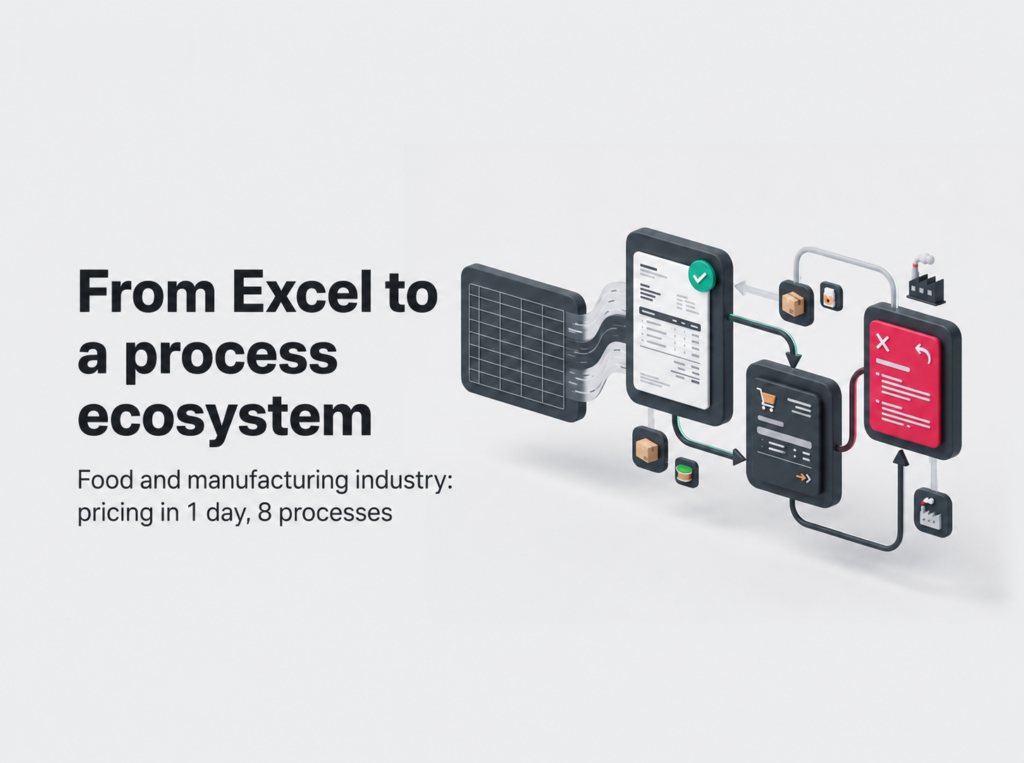
A comprehensive quotation management system reduced quotation preparation time from 2–3 weeks to as little as one day. By integrating production data and built-in validation rules, the system automatically verified key parameters.
-
Automated purchase requisition creation
Production purchase requisitions were generated automatically based on approved quotations. This replaced spreadsheet-based processes and manual data entry, reducing errors and accelerating operations.
-
Returns and complaints management system
The food company also used Qalcwise to manage consumer complaints and product returns. The solution streamlined case registration, analysis, and communication between the departments involved.
Expanding the solution to additional business areas
-
Finished goods management and SAP integration
Data collected in the Qalcwise No-Code Platform was used to support finished goods preparation and integrated with SAP, eliminating the need to duplicate information across multiple systems.
-
CRM built on existing business data
Since the platform already contained project, product, and collaboration data, extending it with customer and lead information enabled the organization to build a practical, fully integrated CRM solution.
-
Operational support tools
Additional Business Applications streamlined day-to-day operations by automatically linking notes, decisions, and operational information to the relevant products, projects, and business processes.
The platform has become the central solution supporting key business processes across both the manufacturing and food companies—from graphic design projects and implementation projects to quotation management, returns and complaints management, and SAP integration.
Most importantly, the customer now develops and enhances most Business Applications independently, enabling rapid changes and continuous adaptation to evolving business needs.
Benefits achieved with Qalcwise
As the platform evolved, it gradually improved the organization's day-to-day operations by enabling faster workflows, better information management, and greater control over business processes.
"We kept adding new features, combining individual stages, and integrating processes until everything started working as one cohesive system. It was a major transformation—and it simply made our day-to-day work much easier.
The platform has become a central environment for connecting business processes, organizing information, and adapting quickly to changing business needs. As a result, both companies can operate more efficiently, improve collaboration, and build a scalable foundation for future growth.
Working with Qalcwise
From the very beginning, the collaboration between the customer and Qalcwise was built on partnership, openness, and flexibility. The customer emphasizes that they received not only technical support but also valuable expertise that helped shape and expand the platform over time.
As a result, Qalcwise became more than a technology provider—it became a trusted partner in the organization's business process transformation.
"I would describe our collaboration as exemplary. I have no reservations. We share our experience with each other.
This approach allowed the customer to evolve the system in line with changing business needs, with the confidence of having a trusted partner throughout the process.
The implementation was carried out in stages, with each enhancement driven by real operational requirements and delivering measurable value from the outset. Over time, the platform became an integral part of the business process transformation across both organizations.
It helped centralize information, automate key business processes, and create a unified working environment spanning multiple departments.
Thanks to its flexibility and the ability to develop Business Applications independently, the platform continues to evolve alongside the organization, supporting new business requirements and enabling continuous process improvement.